
Honoring the Past, Building the Future
CULTURAL STEWARDSHIP
Honoring the Past, Building the Future
October 27, 2026
The earth speaks to those who listen.
Each layer of soil reveals how living things interact with nature. Each generation of life builds upon another. Each soil horizon holds our story in what is left behind, entombs narratives of lived experience in what remains and provides proof that we lived.
The Kids Canal Story
If geology is the science that pieces together the character of a landscape, the practice of a Cultural Resources Specialist (CRS) reveals its soul. Together, they anchor the conservation team shaping a watershed plan, grounding it in the earth’s deep memory and humanity’s enduring presence. One is measured in hundreds of millions of years —a chronicle of ice, fire and water —while the other unearths historic and cultural meaning.
Together they expose not only the disposition of the land but also a sense of place—who we were, who we are and who we might become. A living narrative unfolds underfoot as geologists and cultural resource specialists work side by side – braiding land and legacy into one unfolding story.
A watershed project plan is a complex clockwork of disciplines.
A Cultural Resource Specialist brings equilibrium between progress and preservation, allowing a plan to move with both precision and conscience. It requires integration of environmental analysis, tribal consultation, and ancestral memory so the plan ticks forward in harmony with the land and the people who shaped it.
A Landscape of Memory
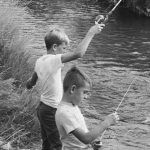
In Vernal, Utah, there is a place where these layers of earth and community meet in an unexpectedly powerful way. Kids Canal — a modest, half mile stretch of open water — is stitched into the memory of generations. It is where childhoods were formed: catching fish, skipping stones, learning to look closely at the natural world. It is a corridor of shade trees fed by canal seepage, a place of gathering, teaching, and…joy.
It is as much a cultural landscape as it is a lifeline for local farms that rely on its water for irrigation.
So, when a watershed project, aimed at improving irrigation efficiency, proposed to pipe the entire length of the Ashley Central Canal — and with it Kids Canal — the community responded in a voice as deep as the generations beneath it. Public outcry was immediate and heartfelt: residents spoke of their ancestral heritage, of the place’s meaning, and of the irreplaceable nature of open water in a modern landscape. Some described tears, fear, and determination.
Friends and families mobilized to document the canal’s stories and protect its future.
Kids Canal was not simply infrastructure. It was — and is — a living cultural resource.
Listening to What the Past Asks of the Present
This is where the work of an NRCS CRS becomes pivotal. When Tara Hoffmann, NRCS Utah Watershed CRS dug into the project history, she discovered what community members had been saying all along: Kids Canal was not merely an irrigation canal— it is an integral part of the community and carries both historical and contemporary significance.
“When I listened to the community talk about Kids Canal, it was clear this place held a deep meaning that had not previously been recognized,” Hoffmann explained. “I knew we had to find a way to keep water in the Kids Canal and preserve this piece of Vernal heritage. I met with pioneer descendants who still live along the canal, listened to childhood stories shared at our public meetings, and visited with the canal company and engineers to find a unified solution.
My role, as the CRS is to weave together environmental compliance, Section 106, and watershed planning. Cultural stewardship isn’t only about protecting what is old; it’s about protecting what is meaningful to people…now!”
— Tara Hoffmann, NRCS Utah Watershed Cultural Resources Specialist
Balancing Progress with Preservation
After months of engagement, analysis, consultation, and collaboration, a new design began to take shape — one that respected public concern, met conservation goals, and honored the Kids Canal’s cultural importance.
The outcome was a model of shared stewardship:
- Kids Canal would remain open, preserving the flowing water experience so central to community identity.
- The trail corridor would be improved for recreation, accessibility, and safety — bridges, benches, shade structures, and ADA features to ensure everyone could continue to enjoy the place.
-
Cultural mitigation would include:
- Piping would be placed on the western bank, protecting the beloved shade trees and trail corridor that rely on canal seepage.
- a kiosk honoring the canal’s history, the habitat, and the watershed project
- water shares dedicated to maintaining flow, and
- the creation of a short documentary film in partnership with the community.
This was not merely a compromise. It was conservation in its truest form — cultural and environmental stewardship in action, showing what becomes possible when a federal project honors the past, responds to the purpose and need before us, and truly listens to the people it serves.
Kids Canal now serves as a powerful example of how environmental planning and cultural resources compliance can bring together an agency and a community, marking the beginning of a new era.
NRCS Investment
WATERSHED PROTECTION AND FLOOD PREVENTION OPERATIONS (WFPO) PROGRAM
$15,958,041
Includes $667,995 cultural resource mitigation costs.
Project Benefits
A benefit to cost ratio compares how much benefit a watershed project produces relative to how much it costs. The benefit of the Ashley Valley Watershed Project to the community of Uintah County and residents of Vernal, Utah will be 4.7 (benefit) to 1 (cost).
BENEFIT-TO-COST RATIO
4.7 : 1
Ashley Valley Watershed Project
Explore More Stories
Explore more stories unearthed by the Cultural Resources team in the StoryMap – UNEARTHED: A Cultural Resource Journey Through Utah’s Watersheds .
Explore a Career with NRCS
Step into a career that protects the past and shapes the future — explore your path to becoming an NRCS Cultural Resource Specialist.
Cultural Resource Specialist – Career information with NRCS
About NRCS
The Natural Resources Conservation Service (NRCS) is an agency of the U.S. Department of Agriculture that works with farmers, ranchers, private landowners and communities to conserve natural resources and support sustainable land management.
For more information, visit nrcs.usda.gov .



Leave a Reply