
From Connected Cabs To Weed-zapping Lasers
How North America Is Learning To Farm Plant By Plant
By Nish Malhotra., Business Development Lead and PMP, GBL and GBI
The fields that popularized GPS autosteer and massive tractors are discovering that true efficiency isn’t about bigger iron, it is about real-time eyesight, lighter machines, and giving living soils a fighting chance. A continental overview.[cite: 56]
THE PRAIRIE CANNOT SIMPLY GROW BIGGER
Farming across North America happens at a dizzying scale. When a single family in Iowa or Saskatchewan manages several thousand acres of corn, soybeans, or canola, technology is not a luxury or a Silicon Valley showcase, it is basic survival. Growers are grappling with persistent rural labor shortages, weeds that shrug off standard herbicides, and volatile fertilizer costs. It is an environment where you simply cannot afford to waste diesel or chemicals.[cite: 56]
Because of this sheer acreage, North America represents over 35% of the world’s precision agriculture market. Forecasters expect the regional market to climb from roughly $3.4 billion toward $9.3 billion to $11.8 billion in the early 2030s, contributing to a global sector projected at $17.29 billion. Yet the most important story in the field today is not about multibillion-dollar projections. It is a quiet, profound change in mindset: moving away from treating an entire section of land like a single uniform carpet, and instead learning to care for every plant on its own terms.[cite: 56]
THE LESSON OF THE CONNECTED CAB: MORE SCREENS, NOT MORE CLARITY
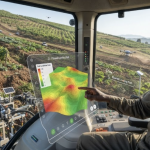
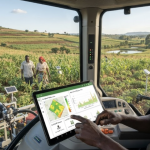
To appreciate where farm tech is heading, it helps to remember where it was just a few seasons ago. Between 2021 and 2025, tractor manufacturers connected virtually everything to the cloud. Platforms like the John Deere Operations Center and Climate FieldView linked millions of acres directly to cab touchscreens. In theory, growers had total visibility. In reality, many ended up with what agronomists called ‘data fatigue’ sitting at the kitchen table late at night, staring at colorful satellite maps that looked impressive but gave few direct answers about what to do in the morning.[cite: 56]
At the same time, the old habit of broadcast spraying was hitting its limits. For generations, farmers applied weed control across 100% of a field, even if weeds covered only 5% of the dirt. Early smart sprayers could spot green weeds on bare soil before planting, but picking out a stubborn green weed hiding inside a thick green corn canopy was an entirely different challenge that took years of trial and error to get right.[cite: 56]
Then came the supply chain shocks of 2022 and 2023. Fertilizer and diesel prices doubled and tripled almost overnight. Suddenly, variable-rate feeding was no longer an experimental hobby, it became a financial necessity. Farmers quickly learned that placing nutrients exactly where the crop needed them could trim synthetic nitrogen use by up to 15% without sacrificing a single bushel at harvest.[cite: 56]
Precision AgTech Insights: North American Innovators[cite: 56]
Comparing Leading AgTech Capabilities[cite: 56]
John Deere[cite: 56]
- Autonomy: Advanced machine autonomy with See & Spray technology.[cite: 56]
- Sensing Tech: Canopy microclimate sensors for precise environmental data.[cite: 56]
- Robotics: LaserWeeder and Autonomous Tractor Kit for effective weeding.[cite: 56]
- Innovation: Industry leader in smart agricultural technology solutions[cite: 56]
AGCO[cite: 56]
- Autonomy: Retrofit kits enhancing existing machines for smart performance[cite: 56]
- Sensing Tech: Multi-depth soil IoT probes for comprehensive soil analysis[cite: 56]
- Robotics: Sub-millimeter aerial leaf scouting for high accuracy.[cite: 56]
- Innovation: Focus on enhancing operational efficiencies in farming[cite: 56]
References Industry reports and technology analysis from 2026.[cite: 56]
MACHINES THAT SEE AND ACT: THE SHIFT TO PHYSICAL AI
Today’s precision tools are fundamentally different because they do not just collect data for later, they act immediately in the field. Four practical technologies are changing daily field work:[cite: 57]
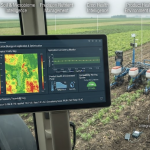
- Eyes that see in milliseconds: Smart cameras mounted along sprayer booms run deep-learning software on the fly. As a sprayer travels at 12 to 15 mph, the machine identifies weeds among crops in the blink of an eye and pulses a micro-drop of herbicide onto the pest. That alone cuts chemical volumes by 60% to 85%, saving growers money while protecting neighboring fields from drift.[cite: 57]
- Giving older tractors new brains: Few farmers can justify trading in their fleet for brand-new autonomous machines costing half a million dollars or more. Modular retrofit kits, like the Carbon Autonomous Tractor Kit (ATK) and PTx systems, bolt onto tractors already sitting in the barn. They add drive-by-wire steering, cameras, and lidar, allowing older iron to till, plant, and weed without a driver in the seat.[cite: 57]
- Field scouts that never get tired: Walking rows in July heat lets an agronomist check only a tiny fraction of a field. Today, solar-powered ground rovers roll between crop rows around the clock, while drones capture detailed leaf photos from above, spotting leaf diseases and insects before they spread out of control.[cite: 57]
- Agronomic assistants you can talk to: Instead of wrestling with clunky software interfaces, farm managers can now type or speak questions in everyday language. Generative AI tools synthesize soil tests, past yields, and upcoming weather to build field-ready application plans in minutes.[cite: 57]
THE FRONTLINE: WHO IS ACTUALLY BUILDING THIS IN THE FIELD
Across North America, a mix of established equipment leaders and focused engineering pioneers are turning these ideas into practical machinery:[cite: 57]
- Carbon Robotics: Instead of spraying weeds with heavier doses of chemicals, Seattle’s Carbon Robotics decided to zap them with light. Their LaserWeeder uses 30 high-power CO2 lasers guided by 36 high-speed cameras to vaporize up to 200,000 weeds an hour. Because the laser heats the weed’s growing center without touching the crop or turning the soil, weed resistance is irrelevant. And with their new Autonomous Tractor Kit (ATK), the tractor can pull the unit without a driver in the cab.[cite: 57]
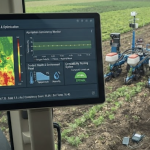
- Solinftec: Solinftec asked a straightforward question: why visit a field once a week when a small machine could live there full-time? Their Solix robot rolls quietly between crop rows powered by the sun. It tracks insects, monitors crop stress, and delivers micro-doses of treatment directly where needed, stopping problems before they get out of hand.[cite: 57]
- Verdant Robotics: In high-value vegetable fields, Verdant’s SharpShooter implement brings precision down to the millimeter. It weeds, thins crowded seedlings, and feeds liquid nutrients right at the root zone, leaving surrounding soil clean and undisturbed.[cite: 57]
- Taranis: Taranis uses drones and light aircraft equipped with high-resolution optical cameras to look at individual leaves across millions of Midwest acres. Their AI pinpoints specific weed types, emergence counts, and microscopic disease spots, delivering actionable tips directly to local agronomists.[cite: 57]
- Arable: Standard weather forecasts are often miles away from what is happening in a farmer’s hollow or hilltop. Arable’s in-field canopy device tracks over 40 variables including leaf temperature, localized rain, and crop water stress helping growers pick the exact right hour to irrigate or spray.[cite: 57]
- CropX: Because roots live underground, CropX places spiral IoT sensors deep into the root zone. They report soil moisture, temperature, and salinity levels, preventing water waste and ensuring expensive fertilizer does not wash below the root reach.[cite: 57]
- John Deere: The machinery giant is bringing smart vision to broadacre farming with See & Spray systems on commercial sprayers, while scaling autonomous 8R row-crop tractors and GUSS orchard sprayers to help farms keep working through tight planting and harvest windows.[cite: 57]
- AGCO/PTx Trimble & Precision Planting: Because most farms run more than one machinery color, AGCO’s PTx division focuses on open-platform retrofit kits. From automated seed downforce to smart spray valves, their tech works across mixed fleets so farmers do not have to buy a single brand.[cite: 57]
AgTech Evolution Overview[cite: 58]
A 10-year timeline of advancements[cite: 58]
- 1 Phase 1: Connected Cabs: Basic GPS autosteer and in-cab displays revolutionized farming data utilization and efficiency.[cite: 58]
- 2 Phase 2: Physical AI: Zero-latency edge processors improved real-time decision-making capabilities in farming practices.[cite: 58]
- 3 Phase 3: Swarm Robotics: Lightweight autonomous robot swarms enhanced crop maintenance and sustainability efforts significantly.[cite: 58]
- 4 Phase 4: Neuromorphic Processors: Introduction of machine vision and drone technology transformed crop management and monitoring.[cite: 58]
- 5 Phase 5: Sustainability Audits: Lightweight autonomous robot swarms enhanced crop maintenance and sustainability efforts significantly.[cite: 58]
WHAT COMES NEXT: LIGHTER SWARMS AND SOILS
For over a century, the standard answer to farm productivity was bigger, heavier iron. But 20-ton tractors packing 500 horsepower take a severe toll on soil, compacting deep layers so roots cannot breathe and rainwater cannot soak in. The next frontier belongs to swarms of smaller, lightweight robots working like ants. Weighing far less, they can plant, weed and scout without crushing soil structure that feeds the crop.[cite: 58]
At the same time, farming is entering the era of ‘crop digital twins’, tracking each plant individually from the day its seed touches the ground through its growth and nutrient needs. Because cell reception across the countryside remains unreliable, these machines must think for themselves on the boom, running cameras and nozzles without an active internet connection. As food buyers ask for proof of sustainable practices, these smart implements automatically record every gallon of diesel saved and pound of chemical spared.[cite: 58]
WHERE ENGINEERING MEETS BIOLOGY: GIVING BIOINPUTS A REAL CHANCE
This is where modern engineering and biological agriculture finally meet. For years, biological products like beneficial fungi, living bacteria, and seaweed extracts struggled with a reputation for being inconsistent in the field. The truth was simple: we were applying living biology with tools built for harsh chemicals. Pumping delicate microbes through high-pressure spray nozzles under the blazing midday sun cooked them before they ever reached the dirt.[cite: 58]
Smart machinery is solving that riddle. Modern planters now feature gentle fluidic systems that place living microbes directly into the furrow next to the seed, shielding them from sunlight and placing them where root exudates can feed them immediately. Meanwhile, intelligent sprayers can zap an invasive weed with a targeted drop of herbicide while misting biological stimulants onto the crop to boost its natural immunity.[cite: 58]
Precision agriculture is no longer just about horsepower or fancy software; it is about building a practical bridge between mechanical tools and living soil biology, keeping farms profitable, productive, and resilient for generations to come.[cite: 58]
BioAg World Digest | Summer 2026

Leave a Reply