
Precision AgTech, ensuring biologicals work consistently
What the World led by Europe are Building
By Khushbu Sindha, Marketing Communications, Content & Editorial Coordinator, BAW Digest
A synthetic pesticide can sit on a leaf for days and still do its job. A living biological, a fungal spore, a beneficial bacterium, a predatory insect has no such safety net. UV light may kill it within hours. Low humidity stops it from working. A badly calibrated spray pump can tear apart its cell walls before it ever reaches the crop. That is why in bioagriculture, precision technology is not a luxury upgrade. It is the basic infrastructure that keeps living organisms alive long enough to work.
What the global biological sector is missing is not new strains of microbes or better product science. What is missing, in every region, at every scale, is the delivery and decision infrastructure that gets living organisms to the right place, at the right moment, in the right condition.
EUROPE: DELIVERY ROBOTS & SATELLITE MAPS
European biological control started in a Dutch greenhouse in 1967. A grower named Jan Koppert released predatory mites onto cucumber plants to fight spider mites, no sprayer, no chemical, just one organism eating another. Twenty years later, Biobest in Belgium built the first commercial bumblebee pollination system. The science was there from the beginning. What took decades to arrive was the engineering layer that makes it work reliably at scale.
Why you cannot put a living organism through a sprayer?
Koppert’s answer to this problem is called Natutec Drive. Instead of hydraulic pressure, it uses rotating drums and low-velocity airflow to move predatory mites and beneficial insects, suspended in a vermiculite carrier, evenly across a crop canopy. It can be mounted on a tractor boom, a greenhouse gantry rail, or existing farm equipment. The result is uniform distribution without any mechanical damage to the organisms being released
For liquid biological sprays, pulse-width modulation (PWM) nozzles have solved a different part of the same problem. These nozzles pulse rapidly, 10 to 20 times per second. keeping droplet size consistent (250 to 350 microns) regardless of how fast the tractor is moving. This eliminates the pressure spikes that tear apart fungal hyphae and bacterial flagella during conventional spraying.
The camera that watches insects so farmers do not have to
In Dutch greenhouse production, a company called PATS has built automated monitoring systems, the PATS-C and Trap-Eye, that use night-vision infrared cameras to watch for insects around the clock. The cameras track wing-beat frequencies and flight patterns to identify specific pests like whiteflies and thrips. Instead of a weekly manual trap count, growers receive continuous population data, with automatic alerts triggered days before pest damage becomes visible [6]. The decision to release a biocontrol agent is no longer a guess. It is based on a population curve.
Satellite maps that tell the spreader how much to apply
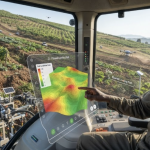
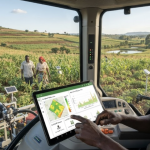
Yara’s Atfarm platform uses European Space Agency Sentinel-2 satellite imagery to compute how vigorous the crop is in every zone of a field. The output is a prescription map a file that tells the fertiliser spreader or spray boom to apply more biostimulant in weak zones and less in strong ones. The system connects directly to ISOBUS-compatible farm equipment, so the variable-rate instruction travels from satellite to field computer to boom controller without any manual input from the farmer
INDIA: DRONES, LASER WEEDERS, AND REAL-TIME SOIL ALERTS
India is farming at a scale and fragmentation that no other country has had to deal with in the precision agriculture era. The average Indian farm is 1.4 hectares. There are over 140 million of them. Monsoon rains arrive unpredictably, temperatures can exceed 42°C during key crop stages, and most farmers are managing multiple crops simultaneously with limited access to technical advice. Delivering a biological input that actually works in this environment requires completely different technology from what Europe has built.
Why a knapsack sprayer is the enemy of a biological?
When an Indian farmer mixes a living microbial inoculant into a knapsack sprayer, two things typically go wrong. First, the water used is often drawn from untreated wells or tanks and may contain chlorine or mineral concentrations that kill the microbes on contact. Second, the coarse nozzles on standard knapsack sprayers produce large, heavy droplets that run off the leaf surface and wash directly into the dry soil below, where the living cells dehydrate within minutes.
Agricultural drones, Kisan Drones-solve both problems at once. They use spinning atomising discs instead of pressure-dependent nozzles, producing a fine mist of droplets between 100 and 150 microns. This is small enough to coat both the upper and lower surfaces of a leaf using only 10 to 15 litres of water per hectare, compared to 150 to 200 litres in conventional spraying. The downward propeller wash from multi-rotor drones physically parts the dense canopy of crops like cotton and basmati rice, pushing the biological suspension deep into the lower plant where pests and fungal diseases shelter.
RAKSHAK: India’s laser weeder that zaps ps weeds without herbicides
Weeds cost Indian farmers an estimated USD 11 billion every year across just 10 major crops, according to ICAR-DWR. Manual removal accounts for 20 to 25 percent of total cultivation costs. The standard alternative herbicides comes with its own risks for biological farming systems, since many herbicide residues disrupt soil microbial communities and harm the same beneficial organisms that biological inputs are designed to deliver.
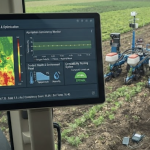
Harvested Robotics, a Hyderabad-based startup founded in 2023 by engineering students Rahul Arepaka and George Mathew, has built “RAKSHAK” a tractor-mounted AI-powered laser weeder designed specifically for Indian farm conditions. The machine mounts onto a tractor that the farmer already owns and uses high-resolution cameras and deep learning computer vision models to identify weeds as the tractor moves through the field. Once a weed is detected, robotic actuators fire a high-power blue laser directly onto the plant’s growing point, destroying it down to the root without touching the surrounding crop.
- Blue laser technology: Blue wavelengths penetrate chlorophyll faster than other colours, destroying the weed’s photosynthetic tissue rapidly and effectively.
- 90% weed detection accuracy with 5 mm tracking precision, meaning the laser hits the weed and misses the crop, even at field speeds.
- Estimated savings of Rs 60,000 per season per farmer in weed control costs, replacing both manual labour and chemical herbicide purchases.
- Completely chemical-free: no herbicide residues, no disruption to soil microbiomes, no harm to the biological inputs applied to the same field.
In early 2025, Harvested Robotics raised Rs 5 crore (approximately USD 580,000) in seed funding led by Arali Ventures, with participation from Anand Mahindra and Chakradhar Gade. The company plans to sell and rent through dealer networks, making the technology accessible without requiring direct farmer capital outlay. RAKSHAK is the clearest Indian expression of a principle that runs through every region in this article: the less herbicide and manual disturbance that enters a biological farming system, the better the biological inputs perform.
Knowing exactly when to spray – the IoT weather station in the field
Cropin Sage, the AI advisory platform from Bengaluru-based Cropin Technologies, which has digitised over 30 million acres across 103 countries, synthesises satellite imagery, local weather station data, and crop phenology models to generate plot-level biological application advisories in regional languages, delivered directly to a farmer’s smartphone.
Fasal deploys small lot sensor nodes directly in the field that measure leaf wetness, canopy temperature, relative humidity and soil electrical conductivity in real time. The sensors track vapour pressure deficit. the atmospheric dryness measure that determines whether a beneficial bacterium like Bacillus subtilis can colonise a root or leaf surface, or whether it will simply desiccate within minutes of application. When the VPD drops into the optimal window typically in the early morning or after rain, the farmer receives an alert. The biology is applied at the moment the environment allows it to work.
JAPAN AND SOUTH KOREA: ROBOTS THAT NEVER MAKE MISTAKES
Japan and South Korea are facing a problem that will eventually reach every agricultural region: the farmers are ageing and the next generation is not replacing them at the same rate. Japan’s average farmer is over 67 years old. South Korea’s food safety regulations set some of the strictest pesticide residue limits in the world. Together, these pressures have pushed East Asian agriculture toward autonomous biological delivery systems that can operate without a human in the cab.
The tractor that places biology exactly at the seed
Japanese machinery manufacturers including Kubota and Yanmar have integrated Real-Time Kinematic (RTK) satellite navigation into autonomous driverless tractors and transplanters. These machines follow pre-programmed field paths with sub-2.5 cm accuracy, a level of precision that makes it possible to meter liquid biological inoculants and microbial consortia directly into the seed furrow at the exact moment of planting. The living bacterial strains are injected into the moist, dark soil immediately at the seed drop point, where they are shielded from UV radiation and dehydration before they can colonise the root system.
Smart greenhouses where the mist only fires when the plant is ready
In South Korean smart farms and Japanese closed greenhouse facilities, biological IPM is managed by environmental control computers that track stomatal conductance and canopy transpiration in real time.
Fogging and misting arrays pulse biostimulant and biofungicide suspensions through micro-nozzles only when relative humidity is above 80 percent and photosynthetic activity is at its peak, the conditions under which foliar biological absorption is most effective. Below that threshold, the system waits. The biology is applied precisely when the plant’s biology is ready to receive it.
AUSTRALIA AND NEW ZEALAND: PREDICTING THE PEST BEFORE IT ARRIVES
Australian and New Zealand farms operate at a scale that would be incomprehensible in most of the world, paddocks of 1,000 to 5,000 hectares, where a single biological application covers more ground than an entire European farming district. GPS autosteer and variable-rate technology are already standard across broadacre grain and oilseed systems. What is arriving now is the predictive software layer that tells those systems exactly when and where to apply a biological.
The algorithm that predicts the 48-hour window
Syngenta’s xarvio BioControl platform, launched in Australia in January 2025, combines satellite biomass growth curves with thermal time calculations known as Growing Degree Day modelling to predict precisely when an insect pest population will reach the economic threshold where biological control is both necessary and effective. The platform generates a 48-hour application trigger for the grower, identifying the window when aphid populations are at their most vulnerable to biological controls and have not yet reached the density where only chemical intervention will suffice.
Releasing parasitoid wasps from a light aircraft
Over millions of hectares of Australian canola, commercial releases of aphid parasitoid wasps specifically Diaeretiella rapae are conducted from light aircraft and aerial drones. The wasps are packaged in biodegradable release capsules that protect them during aerial deployment and break open on landing, dispersing the parasitoids evenly across vast canola paddocks. The combination of xarvio’s algorithmic timing and aerial biological release is the clearest example anywhere in the world of a complete precision bioagriculture circuit: satellite data generates the trigger, the trigger generates the release order, the aircraft executes the release.
Optical spot-sprayer cuts application volume by 90 percent
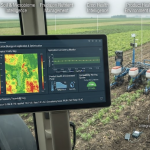
Australian grain growers are deploying 36-to-48-metre booms fitted with high-speed machine vision sensors systems like WEED-IT and Bilberry that scan the ground at 20 to 25 km/h and distinguish green weed tissue against dry crop stubble in milliseconds. The moment a weed is detected, a solenoid valve fires a micro-burst of bioherbicide directly onto the target. Nothing is applied between weeds. Total spray volume is reduced by 70 to 90 percent compared to blanket application which makes the economics of high-cost, specialised bioherbicidal molecules work at broadacre scale for the first time.
SOUTHEAST ASIA: GETTING BIOLOGY THROUGH A TROPICAL CANOPY
Southeast Asian agriculture intensive rice in Thailand and Indonesia, oil palm in Malaysia, export fruit orchards across the Philippines and Vietnam, presents a delivery problem that Europe and Australia do not face: tropical rain. An afternoon monsoon downpour can wash a biological application off every leaf surface within hours of application, before the active organism has had time to colonise, germinate or attach. UV intensity is extreme. Canopies are dense and multilayered.
Drones that push biology through dense tropical crops
Agricultural drones in Southeast Asia use variable-frequency ultra-low-volume nozzles combined with specialised bio-adjuvants and microbial stickers, compounds that help living organisms bond to leaf surfaces and resist wash-off. The downwash aerodynamics of multi-rotor drone propellers create a high-pressure funnel that physically parts the upper rice leaves and deposits Bacillus thuringiensis (Bt) or Beauveria bassiana spores directly onto the leaf sheaths and stem bases, achieving up to 35 percent higher deposition accuracy over conventional manual spraying in field comparisons.
Solar-powered traps that tell cooperatives when to spray
Solar-powered automated insect traps, equipped with optical counters, transmit real-time pest catch data across regional communications networks. When moth populations reach the critical emergence threshold, the brief period when adult insects are active but have not yet laid eggs, farmer cooperatives receive simultaneous alerts and coordinate biological spraying across thousands of hectares at the same moment. Calendar-based spray schedules, which are almost always either too early or too late for biological products, are replaced by population-triggered precision decisions.
THE MIDDLE EAST: WHEN THE IRRIGATION PIPE BECOMES THE DELIVERY SYSTEM
In the Middle East – Israel, Saudi Arabia, the UAE, Turkey, agriculture operates under conditions that make conventional biological delivery almost impossible. Temperatures exceed 45°C in summer. Solar radiation intensity is extreme. Soil salinity levels in many growing regions are high enough to stress most crops, let alone the microbes meant to help them. Foliar-applied biologicals applied under these conditions simply do not survive long enough to work. The solution that Israeli agricultural engineers developed is elegant: do not spray the biology onto the plant. Inject it underground, directly into the root zone, through the irrigation system that is already there.
Israeli pioneers including Netafim and Tevatronic operate automated closed-loop subsurface drip irrigation networks that deliver water 15 to 30 centimetres below ground, directly into the active root zone. Soluble mycorrhizal fungi, Trichoderma inoculants and marine biostimulants are injected into the pressurised irrigation lines and delivered underground, completely bypassing atmospheric UV radiation and evaporative loss. The living microbes arrive in a moist, enclosed soil environment where they can immediately begin colonising root interfaces, stimulating root elongation and activating the plant’s drought and salt stress defences.
Sensors that pulse a biostimulant dose when salinity spikes
Continuous soil capacitance probes monitor real-time soil moisture tension and electrical conductivity around the clock. When a salinity spike is detected, the moment when soil salt concentration rises to the threshold that triggers osmotic stress in the plant, automated controller algorithms release a micro-dose of biostimulant directly into the drip line. The biostimulant primes the plant’s hormonal signalling pathways, inducing the production of proline and abscisic acid to prevent cellular dehydration before any visible stress symptoms appear. It is preventive biological protection, timed to the second by soil chemistry data.
Turkey: Building next-generation biostimulants from waste
In July 2025, a Turkish agritech company registered a research and development cooperation request through the European Enterprise Network, seeking partners in Spain, France, the Netherlands and Belgium to develop biostimulants and organic fertilisers from agricultural waste biomass with controlled-release formulations designed to improve plant resilience against heat and drought stress. The collaboration pattern, Turkish innovation seeking European regulatory expertise, reflects the same market access dynamic that drives every emerging market in this sector: the product science is advancing faster than the regulatory pathways, and building cross-border partnerships is how companies close that gap.
THE MIDDLE EAST: WHEN THE IRRIGATION PIPE BECOMES THE DELIVERY SYSTEM
Across every region in this article Europe, India, Japan and South Korea, Australia and New Zealand, Southeast Asia, and the Middle East, three identical constraints appear in different forms.
The challenge is not only the biology. It is the infrastructure around the biology. It is the infrastructure around the biology, the delivery system, the timing sensor, the advisory platform, that determines whether a living organism survives from the container to the plant and performs as it was designed to.
The three universal bottlenecks
Mechanical protection: Every living biological input needs a delivery system that does not kill it, low-shear rotary dispensers in European greenhouses, centrifugal atomising drones in Indian fields, subsurface drip lines in the Middle East. The container-to-plant journey is where most biological failures happen, and precision application machinery is the solution.
Timing: A biological applied at the wrong moment, when pest pressure is too low to justify the cost, or when relative humidity is too low for germination, or when the plant is already under irreversible stress, will always underperform a chemical alternative. Canopy microclimate sensors, automated trap networks, satellite phenology algorithms and AI advisory platforms all exist to solve this single problem: finding the hour when the biology works.
The advisory gap: In every region, the limiting factor is not the product and not the machinery. It is the recommendation layer that tells a farmer, in their language, on their phone, in the field: apply now, here, at this rate. Where that layer exists, CropIn Sage in India, xarvio in Australia, PRIS alert systems in Africa, Crop-Scanner in Kenyan floriculture biological adoption accelerates. Where it is absent, biologicals remain inconsistent and chemical alternatives retain their advantage.
When living inputs are delivered through calibrated machinery, triggered by sensor data, and timed by phenological algorithms, biological crop protection stops being a weather-dependent gamble. It becomes a reproducible, reliable discipline. That is the transition the global biological sector is currently building, one region at a time.
BioAg World Digest | Summer 2026

Leave a Reply