
WIA 28th Edition with Carrol Plummer, Director, Vivent Biosignals
How Vivent Biosignals pairs electrophysiology and AI to protect crops
Compiled by Sue B, Media Manager and KRM, GBA and GBL | Interview with Carrol Plummer, Co-Founder AND Director at Vivent Biosignals
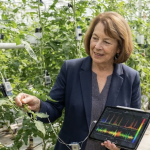
Carrol Plummer is Co-founder and Director of Vivent Biosignals, a Swiss agritech company pioneering the use of artificial intelligence and plant electrophysiology to improve crop health and agricultural sustainability. She has helped grow Vivent from an innovative scientific concept into an international business working across more than 40 crops. Carrol is passionate about translating complex science into practical tools that help growers act earlier, use resources more efficiently, and build more resilient food systems.
Q1: Carrol, you have built your career at the intersection of entrepreneurship, technology and agriculture. What have been the moments in your journey as a woman leader, and what made you keep pushing forward when the path was uncertain?
Two moments changed the direction of my career. Early on at Procter & Gamble, a boss encouraged me to look beyond the safe, local option and apply to one of the world’s leading business schools. I followed that advice, went to INSEAD and suddenly my career and my network became genuinely international.
After an MBA and a short period in strategy consulting, I returned to heavy industry in the UK paper-manufacturing sector. It was a demanding environment, but it gave me real responsibility for large teams and complex operations. I could see opportunities for improvements and new services that nobody yet owned. That was the point at which I moved towards entrepreneurship.
What keeps me going is the combination of a difficult technical problem and a talented team determined to solve it. Uncertainty never disappears; you learn to work with it. I think of each day as part of an adventure, but not a solo one. The commitment to our clients and to the people building the business makes the hard work, creativity and big decisions worthwhile.
Q2: Vivent is taking a very different approach to precision agriculture, essentially “listening” to plants through their electrical signals. From your perspective, how can technologies such as plant biosignals, AI and real-time crop intelligence change the way farmers make decisions?
Precision agriculture has traditionally been very good at answering “where?” Vivent adds another essential question: “when?” We repeatedly see inputs being applied when a crop does not need them or when the plant is not in a position to use them effectively. By monitoring crops continuously, plant biosignals can provide live insight into water and nutrient status and, increasingly, biotic stresses such as pests and disease. AI helps us interpret complex patterns in those signals and turn them into information a farmer can act on. The aim is not to replace the farmer’s judgement; it is to give that judgement a new source of evidence, directly from the crop.
The science itself has deep roots. Jagadish Chandra Bose pioneered the study of plant electrical responses more than a century ago, but the signals were far too complex to interpret at scale. Modern computing and AI are finally making that possible. The challenge is trust: this is a new way of assessing crop health, so farmers need to see the insight work repeatedly in their own conditions.
Q3: Women are often strongly represented in agricultural science and research, but that representation tends to narrow as we move towards entrepreneurship, C-suite and decision-making roles. From what you have experienced, where does that pipeline break down, and what needs to change?
The pipeline rarely breaks at one dramatic point; it leaks over time. Starting and growing a business requires a little “slack” time, money and the freedom to take a risk. Women often have less of all three at exactly the stage of life when founding a company becomes possible.
Vivent is my third venture-backed business, and my experience is that women still tend to raise less money and spend longer closing rounds. Perceived risk is not the same as actual performance, yet those perceptions shape who receives capital and how much runway they have. I have also seen women in senior investment and board roles become highly transactional or risk-averse, perhaps because they feel they must continually prove themselves. That can make it harder for them to provide the active support portfolio companies need.
The answer is not another confidence workshop. Women need practical runway, sponsors who open doors, transparent investment decisions and networks that remain available when careers and personal responsibilities become complicated. We also need to remember that we deserve to be at the table and then use our position to make it easier for the next woman to get there.
Q4: In Precision AgTech and BioAg, innovation often requires years of scientific validation, capital and market development. Do women entrepreneurs face additional barriers in accessing funding, networks, technical expertise or commercial opportunities, and if so, where do you see the biggest gap?
Yes. The biggest gap is not capability; it is continuity. BioAg innovation takes years, and those years often overlap with significant family responsibilities. That can discourage talented women from committing to the intense, uncertain journey of scaling a business or make investors question their commitment before they have even begun.
We need genuinely patient capital for AgTech and BioAg, together with leadership models that do not depend on a single heroic founder carrying everything. Strong teams, shared leadership and practical flexibility make long-term commitment possible. They are not concessions; they are better ways to build companies capable of surviving a long scientific and commercial development cycle.
Q5: You are working at a fascinating intersection of biological intelligence and artificial intelligence. Do you think this convergence creates new opportunities for women scientists, entrepreneurs and innovators to take leadership roles in the next generation of agriculture?
Absolutely. Biological intelligence supplies the context that AI lacks, while AI can reveal patterns in biology that no person could hold in their head. Bringing the two together will challenge some long-standing assumptions about how crops are managed and what we regard as evidence.
That creates space for a kind of leader: someone who can connect disciplines, ask questions and translate complex science into decisions that work in the field. Women and Indigenous innovators can bring perspectives that have too often been excluded from mainstream agricultural innovation, including a stronger focus on interdependence, resilience and long-term stewardship.
But the opportunity will not realise itself. Women need access to data, technical collaborators, capital and visible leadership roles not simply an invitation to contribute once the important decisions have already been made. If we get that right, the convergence of biological and artificial intelligence could broaden both who leads agricultural innovation and what that innovation is designed to achieve.
Q6: One recurring theme in our Women in Agriculture discussions has been that mentorship and sponsorship can be career-defining, but access to the right networks is often unequal. Who were the people or experiences that helped you progress, and what kind of mentorship or sponsorship ecosystem do emerging women leaders in BioAgTech need today?
The early boss who encouraged me to apply to INSEAD changed my trajectory because he saw a larger possibility for me before I saw it myself. INSEAD then gave me an international network that I still value and call upon. Later, colleagues, board members, customers and farmers all became part of the ecosystem from which I learned.
Mentorship matters, but sponsorship is different: a mentor gives advice; a sponsor puts your name forward when you are not in the room. Emerging women leaders need both. I would build an ecosystem around peer groups, cross-border networks and experienced sponsors who make introductions to customers, investors, technical experts and board opportunities. The most useful relationship starts with the challenge a woman is facing now not with a generic programme designed to look good in an annual report.
Q7: There is also a perception challenge: women sometimes self-select out of leadership opportunities, while at other times organisational or societal expectations limit what they believe is possible. How can companies, leaders and women themselves break these barriers and create a culture where leadership is seen as an opportunity rather than an exception?
We should be careful not to treat “self-selection” as a defect in women’s confidence. People opt out when the cost is obvious and the support is not. Companies need to make stretch opportunities visible, invite people before they meet every criterion and ensure that caregiving is compatible with serious leadership responsibility. Leaders should examine who receives informal encouragement, high-profile assignments and permission to learn in public.
Women also have a role: ask for the opportunity, step into it before you feel perfectly ready and accept that leadership does not require pretending to know everything. The cultural shift happens when women are not presented as exceptional cases, but are routinely trusted with authority, budgets and consequential decisions.
Q8: From your experience building Vivent, what leadership qualities do you believe are important for navigating uncertainty, scaling deep-tech innovation and bringing a new technology from scientific concept to real-world agricultural impact?
The next quality is confidence without theatre: be honest about what you do not know, ask your ecosystem for help, and then make a decision. Move forward, learn quickly and pivot when the evidence changes. You need to be coachable and to invest time in relationships because no founder has all the answers.
Above all, respect farmers. They are among the best risk managers I have ever met. A leader must be able to work inside the team when everyone is delivering together, and step outside it when an external perspective or a difficult decision is required. Trust yourself, trust your people and stay close to the reality in the field.
Q9: If Global BioAg Alliance Women in Agriculture for Sustainability Forum were to become a global platform, not simply a discussion forum, what would you want it to provide to women leaders and emerging women leaders? Would you prioritise mentorship, leadership development, investor connections, role models, international networking, or something else?
All of those have value, but I would prioritise mentorship and international networking-provided they are built around action. Women are resourceful at acquiring new skills; what they often lack is access to the people who can accelerate an idea, make an introduction or help solve a difficult problem.
I would like to see small, trusted peer circles; mentor matching based on a current challenge; sponsor-led introductions to investors, customers and board opportunities; and a confidential space where leaders can discuss the problems they cannot address publicly. The test of the platform should not be how many conversations it hosts, but how many doors those conversations open.
Q10: Finally, what is your message to the young woman scientist, entrepreneur or Agtech professional who has the ambition to lead but is still wondering whether there is a place for her at the decision-making table? And what responsibility do today’s leaders, both women and men, have in making that table more inclusive?
Do not wait until you feel completely ready. You do not need every answer; you need a question worth pursuing, evidence that you can learn and the courage to decide before certainty arrives. Your technical knowledge is valuable, but so are your judgement, curiosity and way of seeing the system.
Today’s leaders have a responsibility to do more than issue invitations after the important choices have been made. They should sponsor women before the meeting, share networks and capital, offer visible assignments and give emerging leaders real authority. Inclusion is not measured by who is present in the photograph. It is measured by who can influence the decision, control resources and change the direction of the work.
BioAg World Digest | Summer 2026


Leave a Reply